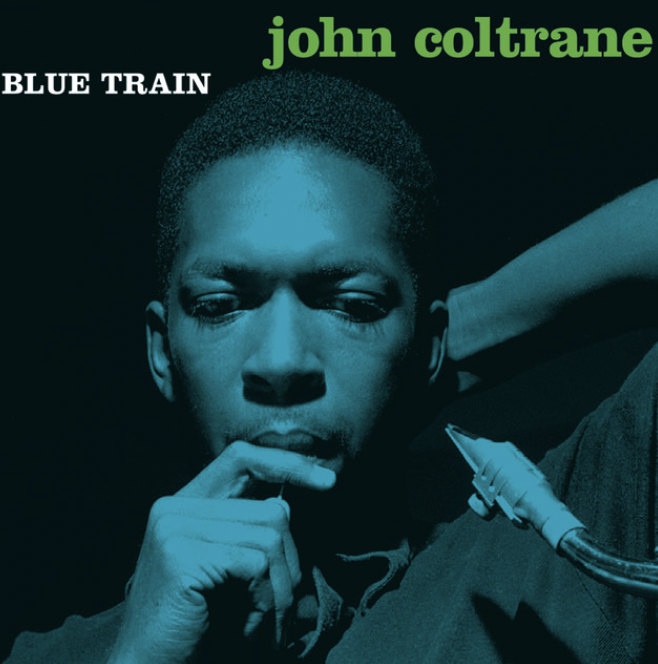
Though it’s the only Blue Note Album Coltrane recorded as a bandleader, it feels like a culmination of all his other recordings; the exhaling voice of Miles Davis, Monk’s asymmetrical punk. Lee Morgan’s trumpet is relatively youthful and brighteyed in comparison to Coltrane’s weathered authority, yet still the conviction telltale of his greatness to come. Curtis Fuller, another up and coming musician on this album provides lovely belting textures and lines to what is quintessentially a blues album. Despite its swinging nature, Coltrane brings the band a seriousness, a spiritual gravity that transcends the hipness of rhythm and harmony and into something far more ethereal, something which we’re left grasping for.
Blue Train opens like the slamming doors of an industrial train. The iron and cigarette smoke plume up from fogged up windows, and the horns are like the wail of an incoming railroad. As soon as Moment’s Notice comes on, it’s then we fully realize the one body that is the band, the one mind. Lee Morgan’s sparking embers are caught by Joe Jones, with that graceful Philly rim shot, and Curtis Fuller’s trombone is a rich brass choir that lends three dimensionality to the harmony.
However, it’s not until “I’m Old Fashioned” that all the tension, the anticipation, and the “Blue Train” that has been building up, leading us on, finally reveals itself. Coltrane suddenly becomes the preacher; it's less he’s performing but speaking to his lifelong love, the saxophone. There’s a tender duality, and we can’t help but feel his eyes are on the horizon.
Thus, Blue Train shows us that the blues, the cornerstone of jazz, can be the messenger, a riveting and soul-stirring substance. Must listen for beginners and professionals alike.